

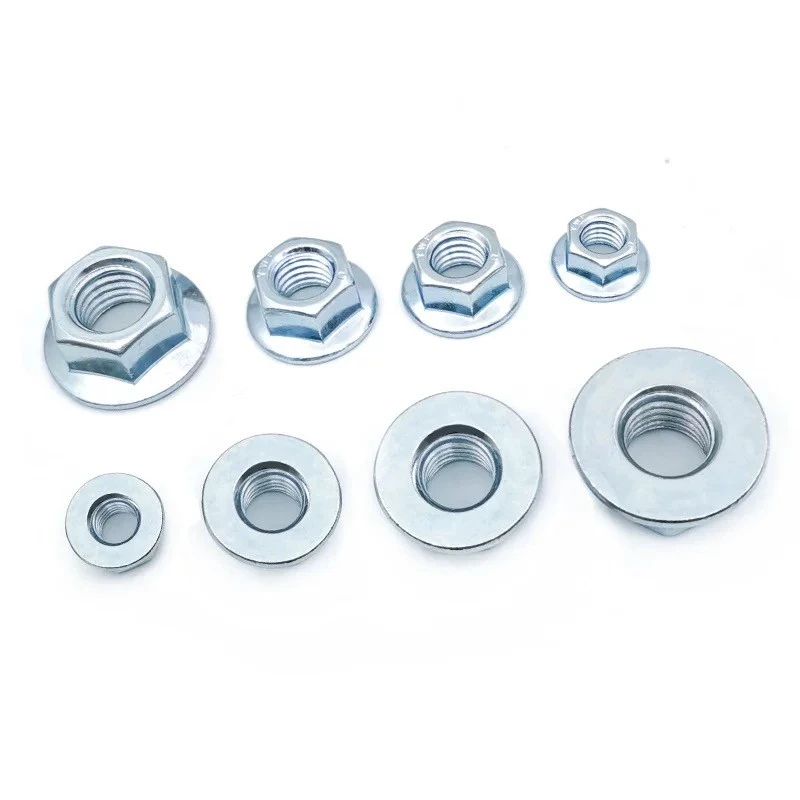
Custom Lock Nut
Description
Technical Parameters
Custom lock nuts are threaded fasteners manufactured to specific drawings, dimensions, material requirements and locking performance criteria. They are used in bolted joints where standard catalog nuts do not meet the required geometry, thread configuration, assembly conditions or resistance to rotational loosening.
Depending on the joint design, custom configurations can include all-metal prevailing torque nuts, nylon insert lock nuts, serrated flange lock nuts and other application-specific designs. Customization may cover thread diameter and pitch, nut height, width across flats, flange dimensions, material grade, mechanical properties and surface finish.
These fasteners are used in automotive components, industrial machinery, agricultural equipment and other mechanical assemblies. Selection depends on the mating bolt, required clamp load, vibration conditions, operating temperature and exposure to moisture or corrosive substances.
Product Features
Custom Dimensions and Threads
Non-standard dimensions, metric or Unified thread systems, special pitches and customized external profiles can be specified through engineering drawings.
01
Multiple Locking Designs
All-metal prevailing torque mechanisms, nylon inserts and serrated bearing faces provide different approaches to resisting loosening. The appropriate design depends on temperature, assembly requirements and joint conditions.
02
Material Options
Carbon steel, alloy steel and stainless steel can be considered according to strength requirements, corrosion exposure and manufacturing feasibility.
03
Surface Finish Selection
Zinc plating, zinc-nickel plating, black oxide, phosphating and suitable non-electrolytic coatings are potential finishing options. Coating selection should account for corrosion requirements, dimensional changes and hydrogen embrittlement risks.
04
Drawing-Based Production
Technical drawings and CAD files define critical dimensions, thread tolerances, material requirements, locking features and inspection criteria.
05
Technical Specifications
|
Parameter |
Specifications / Options |
|
Product Types |
All-metal lock nuts, nylon insert lock nuts, serrated flange lock nuts, custom-profile lock nuts |
|
Thread Systems |
ISO metric threads; ASME Unified UNC/UNF threads |
|
Thread Sizes |
M5–M48; 3/16 in–2 in |
|
Metric Thread Pitch |
Coarse and fine pitches according to ISO metric thread series |
|
Unified Thread Series |
UNC and UNF |
|
Internal Thread Tolerance |
ISO metric: 6H; Unified: 2B |
|
Materials |
Carbon steel, alloy steel, stainless steel |
|
Steel Grades |
C1035, C1045, 40Cr, SCM435, 35CrMo, SUS304, SUS316 |
|
Locking Mechanisms |
All-metal prevailing torque, distorted thread, nylon insert, serrated bearing face |
|
Nut Geometry |
Hex, flange, thin-profile and drawing-specific configurations |
|
Surface Finishes |
Zinc plating, zinc-nickel plating, black oxide, phosphating, non-electrolytic zinc-aluminum coating |
|
Mechanical Verification |
Proof load, hardness and thread gauge inspection, according to the applicable product specification |
|
Dimensional Inspection |
Calipers, micrometers, thread gauges and coordinate measuring equipment, where required |
|
Documentation |
Material test reports, dimensional inspection reports and certificates of conformity, as agreed for the order |
Applications
Automotive and Commercial Vehicles: Custom lock nuts can be specified for suspension brackets, mounting assemblies and other bolted joints requiring defined thread dimensions and locking characteristics.
Agricultural and Construction Machinery: Equipment manufacturers may use drawing-specific nuts in pivot assemblies, mounting brackets and machinery joints exposed to vibration or repeated mechanical loading.
Industrial Machinery: Gearboxes, machine frames and mechanical drive assemblies may require special nut profiles, flange dimensions or locking mechanisms to suit restricted installation space.
Renewable Energy Equipment: Custom fasteners may be considered for mechanical assemblies in wind and solar equipment. Structural joints require separate verification of fastener strength, preload and applicable engineering requirements.
Automation Equipment: Custom dimensions and locking features can support compact mechanical assemblies where standard nut geometry does not fit the installation space.
Key Selection Factors
Thread Compatibility: Specify the thread system, nominal diameter, pitch and tolerance class. Metric and Unified threads are different systems and must not be interchanged without engineering approval.
Bolt Strength and Joint Design: Match the nut's mechanical properties to the mating bolt and joint requirements. Verify proof load, thread engagement, bearing surfaces and installation conditions against the applicable standard.
Locking Mechanism: All-metal prevailing torque designs are worth evaluating for higher-temperature applications. Nylon insert designs provide a different locking mechanism but have temperature and reuse limitations. Serrated flange nuts require consideration of the mating surface and potential surface damage.
Operating Environment: Identify temperature extremes, moisture, salt exposure, chemicals and corrosion requirements. Coating selection must also account for dimensional tolerances and the risk of hydrogen embrittlement in susceptible high-strength steel fasteners.
Assembly Torque and Reuse: Prevailing torque contributes to total installation torque and should be distinguished from the torque needed to generate clamp load. Specify the required installation method and reuse cycles, then verify locking performance using the applicable test procedure.
Frequently Asked Questions
Q: What information is required for a custom lock nut quotation?
A: Provide a dimensioned drawing or CAD file, thread specification, material grade, mechanical requirements, surface finish, estimated quantity and intended application.
Q: Can custom lock nuts use metric and imperial threads?
A: Yes, both ISO metric and ASME Unified thread systems can be specified. The nominal diameter, pitch or threads per inch, and tolerance requirements must be clearly identified.
Q: Which locking design is suitable for vibration?
A: All-metal prevailing torque nuts, nylon insert nuts and other locking designs have different operating limits. Selection should consider vibration direction, temperature, bolt compatibility and required locking performance.
Q: Can inspection reports accompany the order?
A: Material reports, dimensional inspection records and certificates of conformity can be specified in the purchase requirements. Availability and report scope should be agreed before production.
Q: What determines the minimum order quantity?
A: MOQ depends on the manufacturing process, tooling requirements, material availability, finishing operations and order quantity. Prototype and production quantities should be stated separately during quotation.
Request a Quote
For a technical review and quotation, submit the following information:
Drawing or CAD File: PDF, STEP or IGES, including critical dimensions and tolerances.
Thread Details: Metric or Unified thread, nominal diameter, pitch and tolerance class.
Material and Mechanical Requirements: Material grade, property class, hardness or proof load requirements where applicable.
Locking Design: All-metal prevailing torque, nylon insert, serrated flange or another defined configuration.
Surface Finish: Coating type and required corrosion test criteria.
Order Details: Prototype quantity, production batch size, annual demand and target delivery schedule.
Complete specifications help engineering and procurement teams evaluate manufacturability, fastener compatibility, inspection requirements and production costs before placing an order.
Hot Tags: custom lock nut, China custom lock nut manufacturers, suppliers, factory
Previous
No InformationNext
Thin Lock NutSend Inquiry


