

Are there flange nuts for heavy - duty applications?
Aug 29, 2025
Leave a message
Are there flange nuts for heavy - duty applications?
In the world of industrial fasteners, the question of whether there are flange nuts suitable for heavy - duty applications is a crucial one. As a flange nut supplier, I've had the privilege of witnessing firsthand the diverse needs of various industries and the pivotal role that flange nuts play in ensuring the stability and safety of structures and machinery.
Flange nuts are distinct from regular nuts due to their integrated flange at one end. This flange acts as a built - in washer, providing a larger bearing surface. This larger surface area distributes the load more evenly, reducing the risk of the nut loosening over time and preventing damage to the mating surface. But can they withstand the rigors of heavy - duty applications? The answer is a resounding yes.
Heavy - duty applications often involve high - stress environments, such as in construction, automotive manufacturing, and heavy machinery. In construction, for example, large - scale buildings and bridges require fasteners that can endure immense pressure and vibrations. Flange nuts are well - suited for these tasks. Their design allows them to grip tightly, even under the most demanding conditions. The flange spreads the clamping force over a wider area, which is essential when dealing with large and heavy components.
In the automotive industry, heavy - duty vehicles like trucks and buses rely on flange nuts to secure critical parts. Engine components, suspension systems, and axles all need reliable fastening solutions. Flange nuts offer the necessary strength and stability to keep these parts in place, ensuring the safety and performance of the vehicle. They can resist the high - torque forces generated during engine operation and the constant jolts and vibrations experienced on the road.
When it comes to heavy machinery, such as cranes, excavators, and mining equipment, the demands on fasteners are even more extreme. These machines operate in harsh environments, exposed to dirt, moisture, and extreme temperatures. Flange nuts made from high - quality materials, such as alloy steel or stainless steel, can withstand these conditions. Alloy steel flange nuts offer excellent strength and durability, while stainless steel ones provide corrosion resistance, making them ideal for outdoor and wet environments.
Let's take a closer look at some of the specific types of flange nuts that are commonly used in heavy - duty applications. The 22mm Flange Nut is a popular choice. With its larger size, it can handle higher loads and is often used in applications where a significant amount of force needs to be applied. The 22mm dimension provides a good balance between strength and compatibility with larger bolts and components.

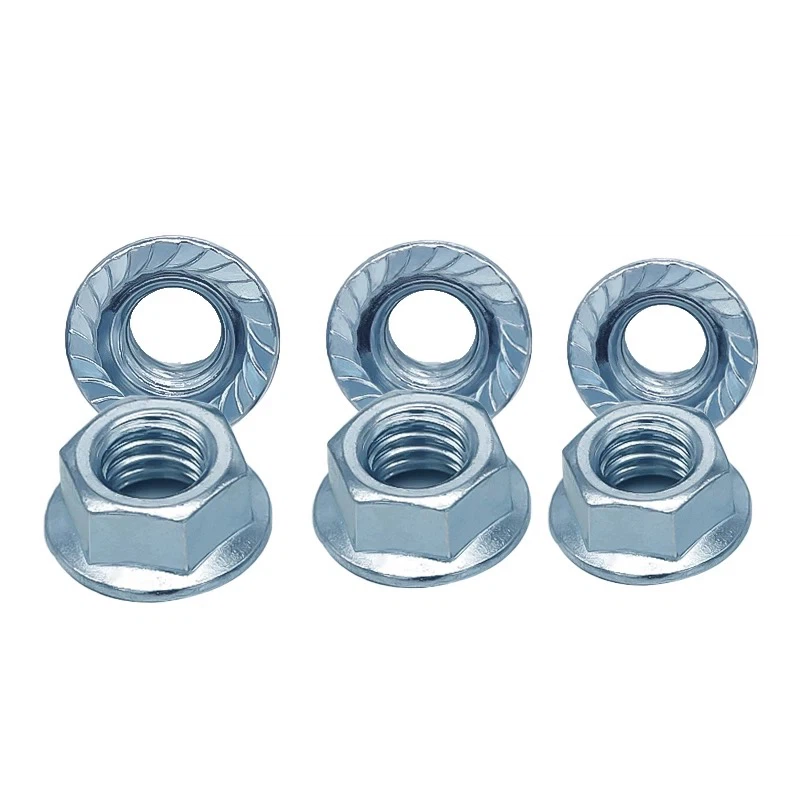
Another important type is the Hex Flange Lock Nut. This nut combines the features of a flange nut with a locking mechanism. The locking feature, such as a nylon insert or a deformed thread, prevents the nut from loosening due to vibrations. This is especially important in heavy - duty applications where even a small amount of loosening can lead to catastrophic failures.
The 16 Flange Nut is also widely used. It offers a good compromise between size and strength, making it suitable for a variety of heavy - duty applications. It can be used in medium - sized machinery and equipment where a certain level of load - bearing capacity is required.
When selecting flange nuts for heavy - duty applications, several factors need to be considered. First and foremost is the material. As mentioned earlier, alloy steel and stainless steel are popular choices. However, other materials like brass or aluminum may also be used depending on the specific requirements of the application. Brass flange nuts are often used in electrical applications due to their good conductivity, while aluminum ones are lightweight and corrosion - resistant, making them suitable for aerospace and some automotive applications.
The thread type is another important consideration. Coarse threads are generally stronger and are better suited for applications where high - torque forces are involved. Fine threads, on the other hand, provide a more precise fit and are often used in applications where a higher level of adjustment is required.
The quality of the manufacturing process also plays a crucial role. High - quality flange nuts are manufactured to strict standards, ensuring consistent dimensions and reliable performance. This includes proper heat treatment to enhance the strength and hardness of the nut, as well as accurate threading to ensure a proper fit with the bolt.
In addition to the technical aspects, cost - effectiveness is also a consideration for many customers. As a flange nut supplier, we understand the importance of providing high - quality products at competitive prices. We work closely with our customers to understand their specific needs and recommend the most suitable flange nuts for their applications. This not only helps them save costs but also ensures the long - term reliability of their equipment.
As a flange nut supplier, we are committed to providing our customers with the best possible products and services. We have a wide range of flange nuts in stock, including those suitable for heavy - duty applications. Our team of experts is always available to provide technical support and advice on the selection of the right flange nuts. Whether you are a construction company, an automotive manufacturer, or a heavy - machinery operator, we can help you find the perfect fastening solution for your needs.
If you are interested in learning more about our flange nuts or would like to discuss your specific requirements, we encourage you to get in touch with us. We are eager to engage in procurement discussions and help you find the most suitable flange nuts for your heavy - duty applications.
References
- Machinery's Handbook: A comprehensive reference for mechanical engineering, which provides detailed information on fasteners and their applications.
- Automotive Engineering Textbooks: These books offer insights into the use of fasteners in the automotive industry, including the requirements for heavy - duty vehicles.
- Construction Industry Standards and Guidelines: These documents outline the specifications for fasteners used in construction, ensuring the safety and stability of buildings and structures.