

What is the thermal expansion coefficient of inner hexagon bolts?
Dec 10, 2025
Leave a message
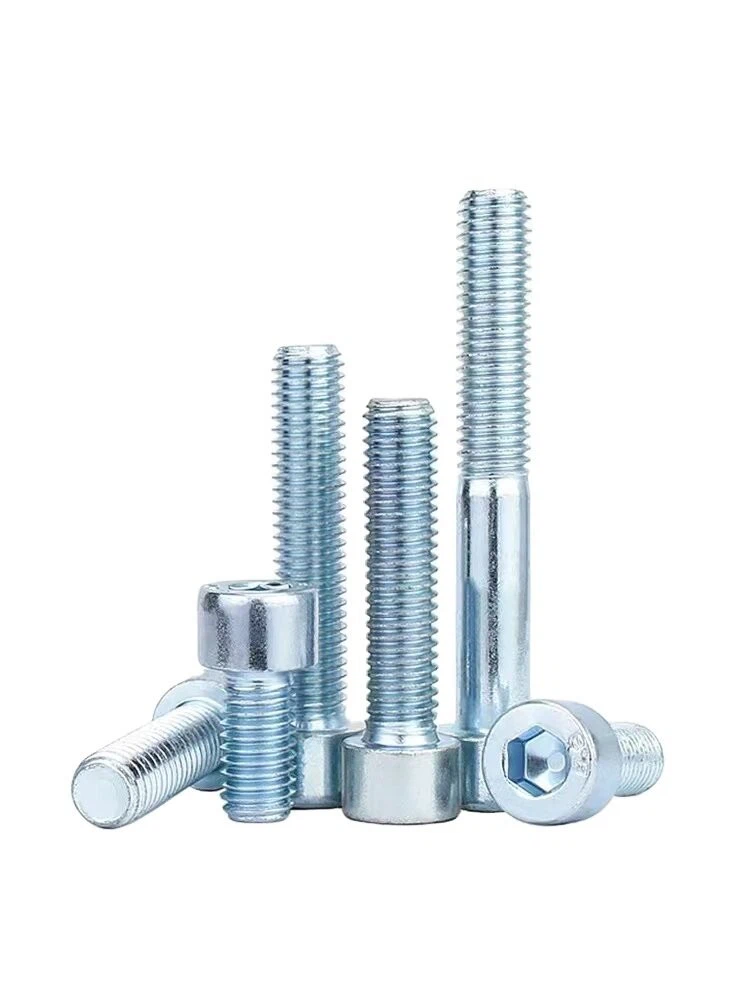
As a supplier of inner hexagon bolts, I often encounter various technical questions from customers. One question that frequently arises is about the thermal expansion coefficient of inner hexagon bolts. This seemingly simple question has far - reaching implications in engineering applications, and today, I'd like to delve into this topic in detail.
Understanding Thermal Expansion
Before we discuss the thermal expansion coefficient of inner hexagon bolts, it's essential to understand what thermal expansion is. Thermal expansion is a well - known physical phenomenon where materials change their dimensions in response to temperature variations. When a material is heated, its atoms or molecules gain kinetic energy and start to vibrate more vigorously. This increased vibration causes the material to expand. Conversely, when the material is cooled, it contracts as the molecular motion decreases.
The thermal expansion coefficient, denoted by $\alpha$, is a measure of how much a material expands or contracts per unit length per degree change in temperature. It is usually expressed in units of $\text{mm}/(\text{m}\cdot^{\circ}\text{C})$ or $\text{in}/(\text{in}\cdot^{\circ}\text{F})$. The general formula for linear thermal expansion is $\Delta L = L_0\alpha\Delta T$, where $\Delta L$ is the change in length, $L_0$ is the original length, $\alpha$ is the thermal expansion coefficient, and $\Delta T$ is the change in temperature.
Factors Affecting the Thermal Expansion Coefficient of Inner Hexagon Bolts
The thermal expansion coefficient of inner hexagon bolts is influenced by several factors:
Material Composition
Inner hexagon bolts can be made from a variety of materials, each with its own unique thermal expansion characteristics. For example, steel is a commonly used material for inner hexagon bolts. The thermal expansion coefficient of carbon steel typically ranges from about $10.8\times10^{-6}\text{ mm}/(\text{mm}\cdot^{\circ}\text{C})$ to $12.5\times10^{-6}\text{ mm}/(\text{mm}\cdot^{\circ}\text{C})$. Stainless steel, on the other hand, has a slightly higher thermal expansion coefficient, usually around $16\times10^{-6}\text{ mm}/(\text{mm}\cdot^{\circ}\text{C})$ to $17\times10^{-6}\text{ mm}/(\text{mm}\cdot^{\circ}\text{C})$.
Alloying elements in the steel can also significantly affect the thermal expansion coefficient. For instance, adding nickel to steel can reduce its thermal expansion coefficient, making it more dimensionally stable under temperature changes.
Heat Treatment
Heat treatment processes such as quenching, tempering, and annealing can alter the microstructure of the bolt material, which in turn affects its thermal expansion properties. A properly heat - treated bolt may have a more uniform and stable thermal expansion behavior compared to an untreated one. For example, annealing can relieve internal stresses in the bolt, resulting in a more predictable thermal expansion coefficient.
Manufacturing Process
The manufacturing process of inner hexagon bolts can introduce residual stresses and inhomogeneities in the material. Cold - headed bolts, for example, may have different thermal expansion characteristics compared to machined bolts due to the different stress distributions and microstructures created during the manufacturing process.
Importance of Knowing the Thermal Expansion Coefficient
Understanding the thermal expansion coefficient of inner hexagon bolts is crucial in many engineering applications:
Structural Integrity
In structures where inner hexagon bolts are used to join components, temperature changes can cause the bolts to expand or contract. If the thermal expansion of the bolt is not compatible with that of the connected parts, it can lead to loosening or over - tightening of the bolts over time. This can compromise the structural integrity of the entire assembly and potentially lead to failure.

Precision Engineering
In precision machinery and equipment, even a small change in the length of the bolts due to thermal expansion can have a significant impact on the performance of the system. For example, in optical instruments or high - precision manufacturing equipment, the dimensional stability of the components is critical. Knowing the thermal expansion coefficient of the inner hexagon bolts allows engineers to design compensation mechanisms to ensure the accuracy of the system under different temperature conditions.
Thermal Expansion Coefficients of Different Grades of Inner Hexagon Bolts
As a supplier, we offer a wide range of inner hexagon bolts, including different grades such as 8.8 Grade Hexagonal Bolt, DIN912 Hexagonal Bolt, and 10.9 Grade Hexagonal Bolt.
The 8.8 grade hexagonal bolts are made of medium - carbon steel and are heat - treated to achieve a certain level of strength. The thermal expansion coefficient of 8.8 grade bolts is similar to that of general carbon steel, typically around $11\times10^{-6}\text{ mm}/(\text{mm}\cdot^{\circ}\text{C})$ to $12\times10^{-6}\text{ mm}/(\text{mm}\cdot^{\circ}\text{C})$.
DIN912 hexagonal bolts are a standard type of inner hexagon bolts. Their thermal expansion coefficient depends on the material they are made of. If they are made of stainless steel, the thermal expansion coefficient will be in the range mentioned earlier for stainless steel.
The 10.9 grade hexagonal bolts are high - strength bolts made of alloy steel. Due to the presence of alloying elements, their thermal expansion coefficient may be slightly different from that of ordinary carbon steel. However, it generally falls within a similar range, around $11\times10^{-6}\text{ mm}/(\text{mm}\cdot^{\circ}\text{C})$ to $13\times10^{-6}\text{ mm}/(\text{mm}\cdot^{\circ}\text{C})$.
Measuring the Thermal Expansion Coefficient
There are several methods to measure the thermal expansion coefficient of inner hexagon bolts. One common method is the dilatometry method. In this method, a sample of the bolt material is heated or cooled in a controlled environment, and the change in its length is measured using a dilatometer. The thermal expansion coefficient can then be calculated based on the measured length change and the temperature change.
Another method is the optical method, which uses optical techniques such as laser interferometry to measure the small changes in length of the bolt due to temperature variations. This method is highly accurate and is often used in research and high - precision applications.
Considerations in Engineering Design
When designing a structure or a system that uses inner hexagon bolts, engineers need to take the thermal expansion coefficient into account. Here are some key considerations:
Material Selection
Choose the bolt material based on the expected temperature range and the thermal expansion characteristics of the connected parts. If the connected parts have a low thermal expansion coefficient, it may be necessary to select a bolt material with a similar coefficient to avoid compatibility issues.
Clearance and Tolerance
Provide sufficient clearance and tolerance in the design to accommodate the thermal expansion of the bolts. This can prevent over - tightening or loosening of the bolts under temperature changes.
Thermal Insulation
In some cases, thermal insulation can be used to reduce the temperature change experienced by the bolts. This can help to minimize the effects of thermal expansion and improve the stability of the structure.
Conclusion
The thermal expansion coefficient of inner hexagon bolts is an important property that can have a significant impact on the performance and reliability of engineering structures and systems. As a supplier, we understand the importance of providing high - quality bolts with well - characterized thermal expansion properties. By choosing the right bolt material, considering the thermal expansion coefficient in the design process, and using appropriate measurement and control methods, engineers can ensure the long - term stability and safety of their applications.
If you are in need of high - quality inner hexagon bolts and have questions about their thermal expansion properties or other technical aspects, please feel free to contact us for procurement and further discussion. We are committed to providing you with the best products and technical support.
References
- Callister, W. D., & Rethwisch, D. G. (2016). Materials Science and Engineering: An Introduction. Wiley.
- Ashby, M. F., & Jones, D. R. H. (2012). Engineering Materials 1: An Introduction to Properties, Applications and Design. Butterworth - Heinemann.