

What is the fatigue life of a Hex Flange Lock Nut?
Sep 08, 2025
Leave a message
Hey there! As a supplier of Hex Flange Lock Nuts, I often get asked about the fatigue life of these little but crucial components. So, let's dive right in and break it down.
First off, what exactly is fatigue life? Well, in simple terms, it's the number of loading cycles a part can endure before it fails due to fatigue. Fatigue failure isn't like a sudden break; it's a gradual process. Small cracks start to form and grow over time as the nut is subjected to repeated stress.
Now, when it comes to Hex Flange Lock Nuts, several factors play a role in determining their fatigue life.
Material Matters
The material used to make the nut is a big deal. High - quality materials like alloy steels are often used because they have better strength and fatigue resistance compared to regular carbon steels. For example, a nut made from a high - grade alloy steel can withstand more stress cycles before showing signs of fatigue. This is because alloy steels have a more uniform grain structure and better mechanical properties, which help them resist the formation and propagation of cracks.
Manufacturing Process
How the nut is made also affects its fatigue life. Precision manufacturing processes ensure that the nut has the right dimensions and surface finish. A nut with a smooth surface finish has fewer stress concentrations. Stress concentrations are like weak spots where cracks are more likely to start. For instance, if there are rough edges or machining marks on the nut, these can act as starting points for cracks. So, a well - manufactured Hex Flange Lock Nut will have a longer fatigue life.

Loading Conditions
The way the nut is loaded is a key factor. If the nut is subjected to constant, low - amplitude vibrations, it can still lead to fatigue failure over time. On the other hand, if it's under high - impact loads, the fatigue life might be significantly reduced. For example, in automotive applications where the nuts are exposed to vibrations from the engine and road conditions, the fatigue life needs to be carefully considered.
Environmental Factors
The environment in which the nut operates can't be ignored. Corrosion is a major enemy of fatigue life. If the nut is exposed to a corrosive environment, like a marine or chemical - laden atmosphere, the corrosion can eat away at the metal, creating pits and reducing the cross - sectional area of the nut. This makes the nut weaker and more prone to fatigue failure. That's why we often recommend using 8 Grade Galvanized Flange Nut in such environments. The galvanized coating provides a protective layer that helps prevent corrosion.
Design Features
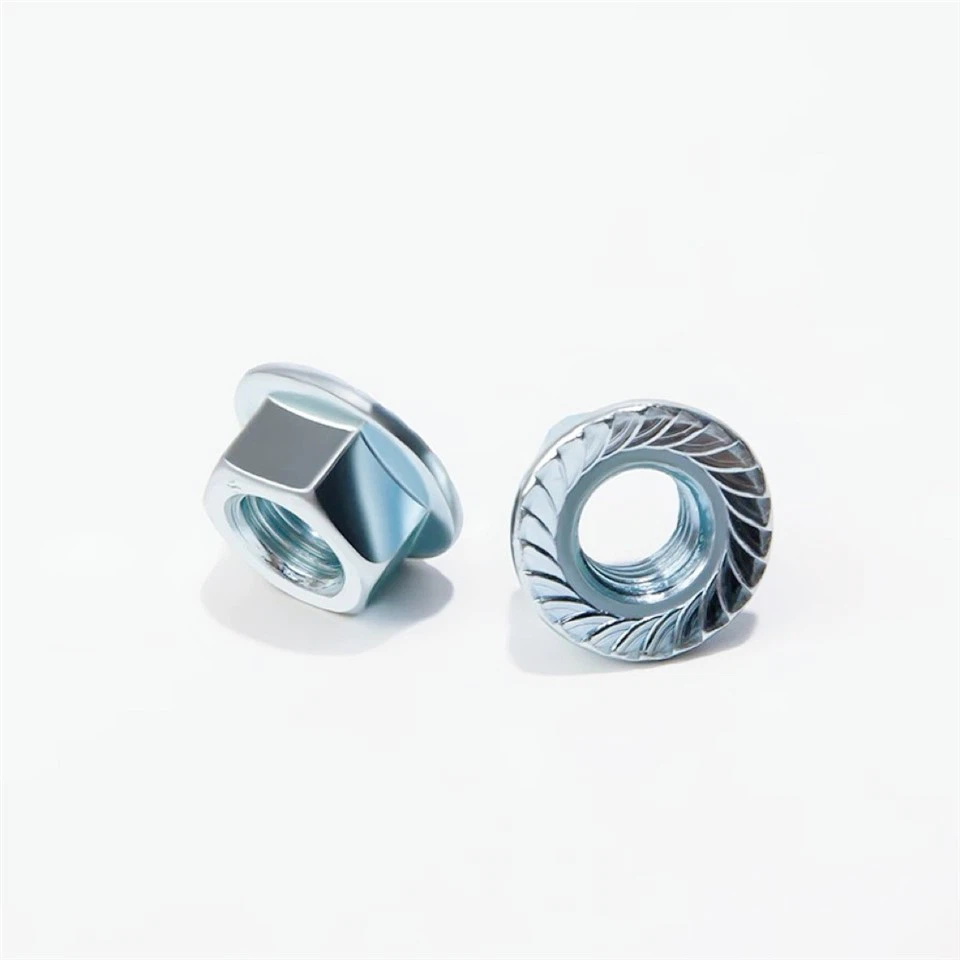
The design of the Hex Flange Lock Nut itself also impacts its fatigue life. The flange on the nut distributes the load more evenly, reducing stress concentrations. This helps to increase the fatigue life. Additionally, the locking mechanism of the nut is important. A good locking mechanism ensures that the nut stays in place and doesn't loosen under vibration, which can prevent additional stress and potential fatigue failure.
Testing and Evaluation
To determine the fatigue life of a Hex Flange Lock Nut, we conduct various tests. One common test is the fatigue test, where the nut is subjected to a controlled number of loading cycles. We measure the number of cycles it takes for the nut to fail. These tests are done under different loading conditions to simulate real - world scenarios.
We also use advanced simulation techniques to predict the fatigue life of the nut. Computer - aided engineering (CAE) software can analyze the stress distribution in the nut and estimate how many cycles it can withstand before failure. This helps us to optimize the design and manufacturing process to improve the fatigue life.
Industry Standards
There are industry standards that govern the fatigue life of fasteners, including Hex Flange Lock Nuts. These standards provide guidelines on testing methods, minimum fatigue life requirements, and quality control. Adhering to these standards ensures that our nuts meet the expectations of our customers and are suitable for various applications.
Applications and Fatigue Life Requirements
Different applications have different fatigue life requirements. In the aerospace industry, for example, the fatigue life requirements are extremely high. The nuts used in aircraft engines and structural components need to be able to withstand millions of loading cycles without failure. On the other hand, in some less - critical applications, like furniture assembly, the fatigue life requirements might be lower.
Let's take a look at some specific types of flange nuts and their potential fatigue life applications:
- DIN6923 Flange Nut: These nuts are widely used in machinery and equipment. Their design and manufacturing quality make them suitable for applications where a certain level of fatigue resistance is required. They can handle moderate vibrations and loads, and with proper installation and maintenance, they can have a decent fatigue life.
- 16 Flange Nut: This type of nut is often used in automotive and industrial applications. They are designed to withstand the dynamic loads and vibrations associated with these applications. Their fatigue life is carefully engineered to meet the specific requirements of these industries.
Improving Fatigue Life
As a supplier, we're always looking for ways to improve the fatigue life of our Hex Flange Lock Nuts. We invest in research and development to find better materials and manufacturing processes. For example, we're exploring the use of new alloy compositions that offer even better fatigue resistance.
We also provide our customers with installation and maintenance guidelines. Proper installation, such as using the correct torque, can significantly improve the fatigue life of the nut. And regular maintenance, like checking for signs of corrosion or wear, can help catch potential problems early.
Conclusion
So, the fatigue life of a Hex Flange Lock Nut is influenced by a variety of factors, including material, manufacturing process, loading conditions, environmental factors, and design features. As a supplier, we take all these factors into account to ensure that our nuts have a long and reliable fatigue life.
If you're in the market for high - quality Hex Flange Lock Nuts or have any questions about their fatigue life and suitability for your application, don't hesitate to get in touch. We're here to help you make the right choice and ensure that your projects are a success.
References
- "Mechanical Engineering Design" by Joseph E. Shigley and Charles R. Mischke
- "Fasteners and Fixings Handbook" by Christopher Hoyle