

What is the elastic modulus of double head bolts?
Sep 21, 2026
Leave a message
What is the Elastic Modulus of Double Head Bolts?
As a trusted double head bolt supplier, I often encounter questions from customers regarding the technical aspects of our products. One of the most frequently asked questions is about the elastic modulus of double head bolts. In this blog post, I will delve into the concept of elastic modulus, its significance in double head bolts, and how it affects the performance of these essential fasteners.
Understanding Elastic Modulus
The elastic modulus, also known as Young's modulus, is a fundamental property of materials that measures their stiffness or resistance to elastic deformation. It is defined as the ratio of stress (force per unit area) to strain (deformation per unit length) within the elastic range of a material. In simpler terms, the elastic modulus tells us how much a material will stretch or compress under a given load before it starts to deform permanently.
Mathematically, the elastic modulus (E) is expressed as:
[ E = \frac{\sigma}{\epsilon} ]
where (\sigma) is the stress and (\epsilon) is the strain.
The elastic modulus is typically measured in pascals (Pa) or gigapascals (GPa). Different materials have different elastic moduli, which depend on their atomic structure, chemical composition, and manufacturing processes. For example, steel has a relatively high elastic modulus, typically around 200 GPa, while aluminum has a lower elastic modulus of about 70 GPa.
Importance of Elastic Modulus in Double Head Bolts
The elastic modulus plays a crucial role in the performance of double head bolts. When a double head bolt is tightened, it is subjected to a tensile force that causes it to stretch. The elastic modulus determines how much the bolt will stretch under a given load and how much force is required to achieve a specific level of preload.
A high elastic modulus means that the bolt is stiffer and will stretch less under a given load. This is important because it allows the bolt to maintain its preload over time, even when subjected to external forces or vibrations. A bolt with a low elastic modulus, on the other hand, will stretch more easily and may lose its preload, leading to loosening and potential failure.
In addition to maintaining preload, the elastic modulus also affects the fatigue life of double head bolts. Fatigue failure occurs when a bolt is subjected to repeated loading and unloading cycles, causing it to crack and eventually break. A bolt with a high elastic modulus is more resistant to fatigue because it can withstand higher stresses without deforming permanently.
Factors Affecting the Elastic Modulus of Double Head Bolts
The elastic modulus of double head bolts can be affected by several factors, including the material composition, heat treatment, and manufacturing process.

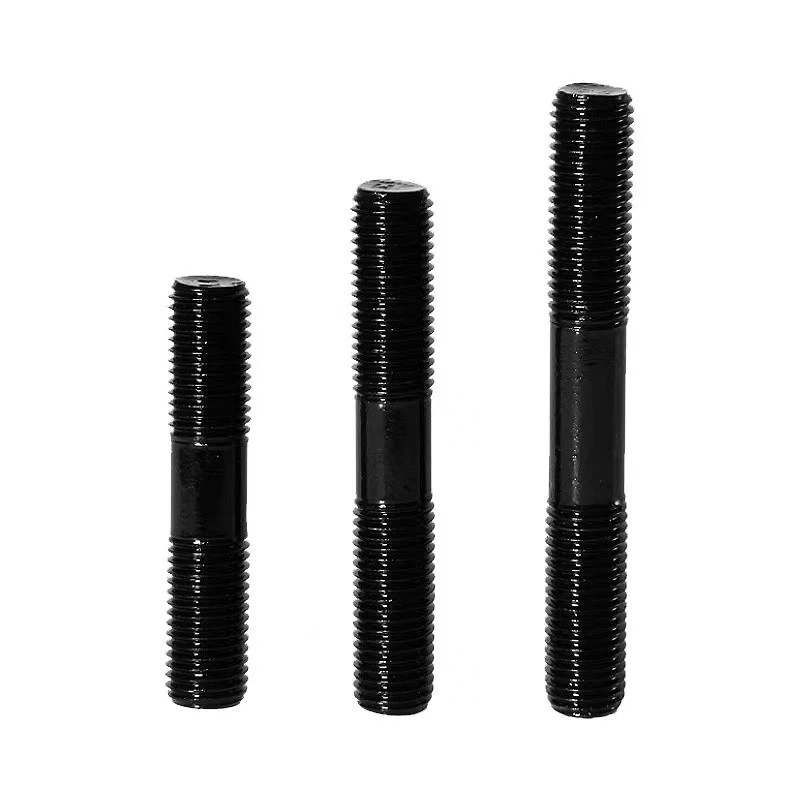
- Material Composition: The type of material used to manufacture the double head bolt has a significant impact on its elastic modulus. For example, steel bolts typically have a higher elastic modulus than aluminum bolts. The specific alloy composition of the steel can also affect the elastic modulus. For instance, high-strength steels may have a slightly higher elastic modulus than mild steels.
- Heat Treatment: Heat treatment is a process used to improve the mechanical properties of metals, including the elastic modulus. By heating and cooling the bolt in a controlled manner, the internal structure of the material can be altered, resulting in changes in its mechanical properties. For example, quenching and tempering can increase the strength and hardness of the bolt, which may also affect its elastic modulus.
- Manufacturing Process: The manufacturing process used to produce the double head bolt can also affect its elastic modulus. For example, bolts that are cold-formed may have a slightly different elastic modulus than bolts that are hot-formed. The surface finish of the bolt can also affect its elastic modulus, as a rough surface may cause stress concentrations and reduce the overall stiffness of the bolt.
Elastic Modulus of Different Types of Double Head Bolts
There are several types of double head bolts available in the market, each with its own unique properties and applications. The elastic modulus of these bolts can vary depending on the material and design.
- 10.9 Grade Black Double-head Bolt: These bolts are made of high-strength alloy steel and are heat-treated to achieve a minimum tensile strength of 1000 MPa. The elastic modulus of 10.9 grade black double-head bolts is typically around 200 GPa, which makes them suitable for applications where high strength and stiffness are required.
- GB901 Double-headed Bolt: These bolts are manufactured according to the Chinese national standard GB901 and are commonly used in general engineering applications. The elastic modulus of GB901 double-headed bolts depends on the material used, but it is typically in the range of 190 - 210 GPa.
- DIN2510 Double-headed Bolt: These bolts are designed according to the German standard DIN2510 and are widely used in the automotive and machinery industries. The elastic modulus of DIN2510 double-headed bolts is similar to that of other high-strength steel bolts, typically around 200 GPa.
Measuring the Elastic Modulus of Double Head Bolts
The elastic modulus of double head bolts can be measured using a variety of techniques, including tensile testing and ultrasonic testing.
- Tensile Testing: Tensile testing is the most common method for measuring the elastic modulus of materials. In this test, a sample of the bolt is subjected to a gradually increasing tensile force until it reaches its yield point or breaks. The stress and strain are measured during the test, and the elastic modulus is calculated using the formula ( E = \frac{\sigma}{\epsilon} ).
- Ultrasonic Testing: Ultrasonic testing is a non-destructive testing method that can be used to measure the elastic modulus of materials without damaging the sample. In this test, ultrasonic waves are sent through the bolt, and the velocity of the waves is measured. The elastic modulus can then be calculated based on the relationship between the wave velocity and the material properties.
Conclusion
The elastic modulus is an important property of double head bolts that affects their performance and reliability. A high elastic modulus ensures that the bolt can maintain its preload over time and resist fatigue failure. As a double head bolt supplier, we understand the importance of providing high-quality bolts with consistent elastic modulus values. Our 10.9 Grade Black Double-head Bolt, GB901 Double-headed Bolt, and DIN2510 Double-headed Bolt are all manufactured using high-quality materials and advanced manufacturing processes to ensure optimal performance.
If you are in the market for double head bolts and have any questions about the elastic modulus or other technical aspects of our products, please feel free to contact us. We are always happy to assist you in finding the right bolts for your specific application.
References
- Callister, W. D., & Rethwisch, D. G. (2011). Materials Science and Engineering: An Introduction. Wiley.
- Shigley, J. E., Mischke, C. R., & Budynas, R. G. (2004). Mechanical Engineering Design. McGraw-Hill.