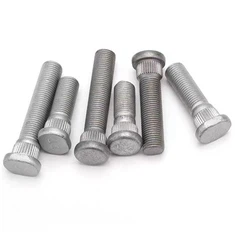
Socket Head Shoulder Bolt
Description
Technical Parameters
Socket head shoulder bolts are precision fasteners with a cylindrical, unthreaded shoulder between the head and threaded section. Also called shoulder screws or stripper bolts in tooling applications, they serve as locating pins, pivot shafts, and guide elements in mechanical assemblies.
The smooth shoulder provides a bearing surface for components that rotate, slide, or require accurate positioning. Typical applications include stamping die stripper plates, automation linkages, fixtures, and guide rollers. Selection depends on shoulder diameter, shoulder length, thread dimensions, material, surface finish, and the required fit with mating components.
Product Features
Cylindrical Shoulder: The unthreaded section provides a defined bearing surface for locating or moving components. Shoulder diameter and length determine the available contact area and installed position.
Socket Head Drive: The internal hex socket allows tightening with a hex key or hex bit, making installation practical in assemblies with restricted wrench access.
Metric and Inch Threads: Metric and Unified thread options support different equipment and tooling requirements. Thread diameter, pitch, and engagement length should match the mating component.
Material Options: Alloy steel and stainless steel options can be selected according to mechanical requirements, environmental exposure, and the applicable product specification.
Custom Dimensions: Non-standard shoulder lengths, diameters, thread lengths, and head dimensions can be specified through engineering drawings, subject to manufacturing capability.
Technical Specifications
|
Specification |
Metric Series |
Inch Series |
|
Product type |
Socket head shoulder bolt |
Socket head shoulder bolt |
|
Shoulder diameter |
6–24 mm |
1/4–1 in |
|
Shoulder length |
10–200 mm |
1/2–6 in |
|
Thread size |
M5–M20 |
#10-24 to 3/4-10 UNC/UNF |
|
Thread system |
Metric coarse or fine |
Unified UNC or UNF |
|
Material options |
Alloy steel; stainless steel options by series |
Alloy steel; stainless steel options by series |
|
Steel strength class |
Class 10.9 or 12.9 |
Class and mechanical requirements according to the applicable product specification |
|
Stainless steel options |
AISI 304 or 316; grade and strength requirements to be specified |
AISI 304 or 316 |
|
Head configuration |
Standard socket head; other profiles by drawing |
Standard socket head; other profiles by drawing |
|
Surface finish |
Black oxide, zinc plating, or specified coating |
Black oxide, zinc plating, or specified coating |
|
Dimensional reference |
ISO 7379 where the product conforms to its requirements |
Applicable ASME standard or customer drawing |
|
Inspection items |
Shoulder diameter, shoulder length, thread dimensions, head dimensions, and visual condition |
Shoulder diameter, shoulder length, thread dimensions, head dimensions, and visual condition |
Materials and Surface Treatments
Alloy Steel: Suitable grades can be selected for tooling and machinery according to the required mechanical properties. Property classes 10.9 and 12.9 should only be specified when the fastener meets the applicable requirements. Load capacity also depends on shoulder geometry, the shoulder-to-thread transition, installation, and loading conditions.
Stainless Steel: AISI 304 and 316 may be considered for applications requiring corrosion resistance. Selection should account for moisture, chemicals, temperature, and mechanical requirements. Stainless steel designation alone does not establish load capacity or service life.
Black Oxide and Zinc Plating: Black oxide is a conversion finish used on steel fasteners where minimal dimensional change is important. Zinc plating provides an alternative corrosion-protection system. Performance depends on coating thickness, post-treatment, exposure conditions, and applicable test requirements.
Passivation may be specified for stainless steel where appropriate. Electropolishing and specialized coatings require confirmation of material compatibility, dimensional effects, and availability. Coating thickness should be considered when specifying shoulder fits and thread tolerances.
Applications
Stamping Dies and Tooling
Used to locate stripper plates, retainers, and selected moving tooling components. Shoulder dimensions and alignment should suit the assembly's movement and clearance requirements.
Automation Equipment
Used as pivot or locating elements in linkages, fixtures, and positioning mechanisms. Selection depends on load direction, movement frequency, and required clearance.
Molds and Die Assemblies
Used to position or support components where the design permits. Operating temperature, lubrication, and loading conditions should be checked against the selected material and finish.
Conveyor Mechanisms
The shoulder can provide a mounting or bearing surface for rollers and linkages. Verify radial loads, axial retention, alignment, and mating dimensions.
Key Selection Factors
Shoulder Diameter and Fit: Match the shoulder to the mating hole and required clearance. Specify both component tolerances when a defined running or locating fit is necessary.
Shoulder Length: Account for component thickness, required clearance, and clamping-stack dimensions to prevent unwanted clamping of moving parts.
Thread Engagement: Confirm thread diameter, pitch, length, and mating material. The threaded section must provide suitable engagement without interfering with the shoulder's bearing function.
Loading Conditions: Consider shear, bending, axial tension, impact, and cyclic loading. Strength class alone does not establish suitability for every application.
Environment and Finish: Specify exposure to moisture, chemicals, temperature, and lubrication. Check coating compatibility with dimensional requirements and applicable regulations.
Our Certificate


FAQ
Q: Can shoulder bolts be manufactured to custom drawings?
A: Custom shoulder diameters, lengths, thread dimensions, and head configurations can be reviewed against the supplied engineering drawing and manufacturing requirements.
Q: What dimensional information is needed for a precision shoulder bolt?
A: Provide shoulder diameter and length, their tolerances, thread specification, head dimensions, and the required fit with the mating component.
Q: Can inspection documents be supplied?
A: Available inspection records and material documentation should be agreed upon when placing the order. Specify any required material certificates, dimensional reports, or additional tests in the purchase specification.
Request a Quote
To request pricing and technical review, provide the applicable standard or engineering drawing, shoulder diameter and length, thread size and pitch, material grade, surface finish, quantity, and delivery destination. Include fit tolerances, loading conditions, and inspection requirements when these affect product selection.
Hot Tags: socket head shoulder bolt, China socket head shoulder bolt manufacturers, suppliers, factory
Previous
Hex Head Shoulder BoltNext
No InformationSend Inquiry